
The Art of Ceylon Tea Cultivation
Discover the meticulous craftsmanship behind growing the world's finest tea in the fertile, sun-drenched lowlands of Sri Lanka.
The Birthplace of Finest Tea
Sri Lanka's diverse landscape offers unique terroirs, from the misty high peaks to the vibrant, fertile lowlands. At Wewelkandura, situated in the historic Sabaragamuwa region, we have cultivated the ancient craft of tea production for generations. Our estate thrives in a climate defined by warm temperatures, abundant tropical rainfall, and rich, mineral-dense soils weathered from ancient metamorphic rock. These conditions give our low-grown teas their unmistakable, deeply satisfying character.
The tea plant Camellia sinensis is, if left to its own devices, a small tree that can grow over ten metres tall and live for more than a century. Under cultivation, it is carefully maintained as a waist-high bush. Regular pruning concentrates the plant's energy directly into producing the tender, young shoots we harvest, perfectly adapting the crop to our regional soils, which are naturally acidic and rich in minerals.
The Two Monsoons
Sri Lanka's weather is shaped by two great monsoons: the south-west, arriving in May, and the north-east, arriving in November. Each brings heavy rains to one side of the central mountain divide while leaving the opposite side in a relative dry period. This creates distinct "seasonal" flushes across the island — such as the Uva region's famed dry-weather teas from July to September, and Dimbula's celebrated quality season in January and February. At Wewelkandura, we precisely time our plucking cycles, pruning schedules, and factory runs to dance to this monsoonal rhythm.
Plucking: The Critical First Step
True quality begins with the classic "two leaves and a bud" — the tender, young shoot that carries the highest concentration of flavor compounds and natural antioxidants. Our skilled pluckers walk the contoured rows each morning, selecting only the finest flush by hand. A single plucker harvests around 16–20 kg of green leaf per day; it takes roughly 4 kg of fresh leaf to produce 1 kg of finished tea.
Plucking is both physically demanding and highly skilled. Our senior pluckers can distinguish at a glance between a true, pristine two-leaves-and-a-bud shoot and a slightly over-mature growth that would compromise grade quality. Rows are plucked on a strict 7- to 10-day "round" to catch each shoot at its prime. Too often, and the bush is stressed; too rarely, and the leaves grow coarse, altering the flavor profile.
Altitude and Flavour
Every 300 metres of elevation change across Sri Lanka produces a measurable shift in the cup, establishing altitude as a critical provenance marker on every genuine Ceylon tea label.
While the freezing air of high-grown peaks produces light, floral liquors, the warmer, nutrient-rich environment of the low country (below 2,000 feet) yields something entirely different. Low-grown teas, like those from our region, are celebrated worldwide for their intensely deep, malty, and full-bodied character. Sporting a highly stylish, dark leaf, these teas offer a natural richness and caramel sweetness that makes them intensely sought after for premium single-origin profiles and robust breakfast blends alike.
Pruning, Nursery, and Replanting
Every three to four years, each tea bush on our estate undergoes a precise maintenance pruning. Because the low-country climate accelerates vegetative growth, this timeline is essential to clear away old wood and stimulate a clean, fresh "frame" of highly productive shoots. Pruning is carefully staggered across the estate so that only a small portion of our fields is out of production at any given time.
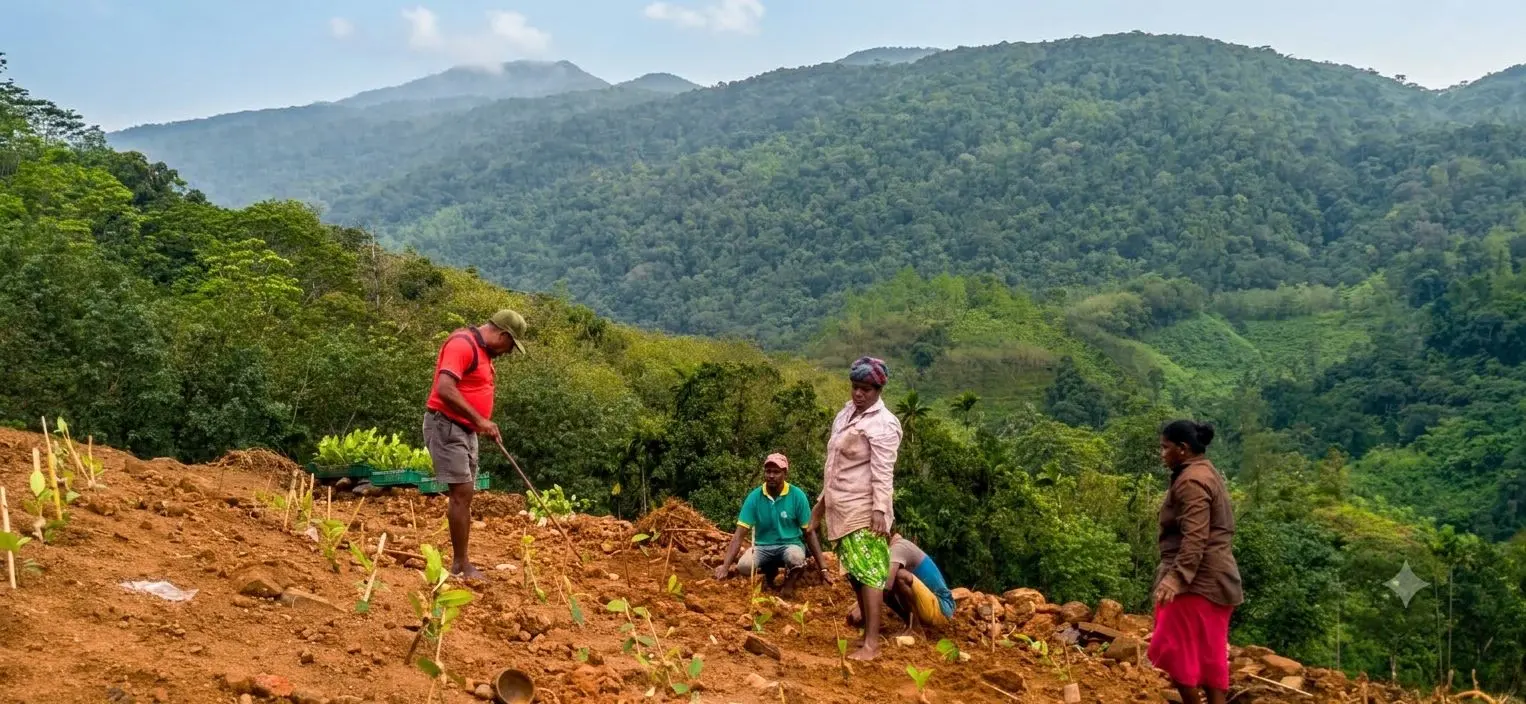
In our on-site nursery, we propagate more than 30,000 saplings a year from selected mother bushes, growing each one for 12–18 months before it is ready to be planted out in the field.
Replanting is a 60-year decision. The cultivar we choose today will shape the quality, yield, and climate-resilience of that field until our grandchildren are running the estate.
Cultivars: The Living Library
Ceylon tea is grown from a range of specialized cultivars developed by the Tea Research Institute (TRI) of Sri Lanka to withstand regional pests and maximize flavor profiles. At Wewelkandura, we maintain a mixed planting of seven distinct cultivars, notably including TRI 2025 and TRI 4043 legendary low-country varieties highly prized for their robust yields and natural tolerance to local environmental pressures. This biodiversity is a practical hedge against disease outbreaks, climate shocks, and changing market tastes.
Pest Management Without Shortcuts
We have moved away from routine synthetic pesticide use in favor of Integrated Pest Management (IPM). Pheromone traps monitor insect populations in real time, guiding targeted, minimal-dose interventions only when pest pressure crosses a strict threshold. Shade trees like silver oak harbor predator birds and beneficial insects, while neem oil, grown and pressed right on the estate, naturally handles common leaf-hoppers and mites. The result is healthier bushes, cleaner tea, and a much lower environmental footprint.
Sustainable Soil Management
Healthy tea starts with healthy soil. We practice no-till cultivation, maintain live mulch between the rows, and apply rich compost derived from spent tea grounds and organic waste. Our soil carbon levels have risen steadily over the past decade — good news for both flavor complexity and the planet.
Terracing along the contours of our steep hillsides prevents vital topsoil erosion during heavy monsoon rains. Leguminous ground covers, planted between the rows, fix atmospheric nitrogen and naturally return it to the soil as they decompose, dramatically reducing our reliance on synthetic fertilizers. These are techniques our grandparents would have recognized, now validated by modern agronomy and supported by digital soil-monitoring data.
The Rhythm of the Year
The tea calendar never stops. January and February bring the prized dry-weather flush. March to April is a heavy plucking period. May signals the arrival of the south-west monsoon, shifting our focus to intensive field maintenance. June to September marks our primary pruning seasons for targeted field blocks. October through December sees another heavy flush as the north-east monsoon arrives. This constant, patient cycle is what makes tea farming a life's work rather than just a job.
Looking Ahead
Climate change poses a real challenge to traditional agriculture, making shifting rainfall patterns and rising temperatures an unpredictable reality. At Wewelkandura, we actively invest in micro-weather monitoring, strategic shade canopies, and heritage cultivars selected specifically for drought resilience to ensure the next generation inherits a thriving garden.
Our research partnership with the Tea Research Institute focuses on identifying cultivars with greater climate tolerance and lower water requirements. We are also trialling agroforestry plots, where tea is grown alongside native jackfruit and cinnamon trees — a return to the resilient, multi-layered farming systems that existed in the region long before tea ever arrived. The art of Ceylon tea cultivation has never been static; each generation refines it anew, in dialogue with the land it depends on.