
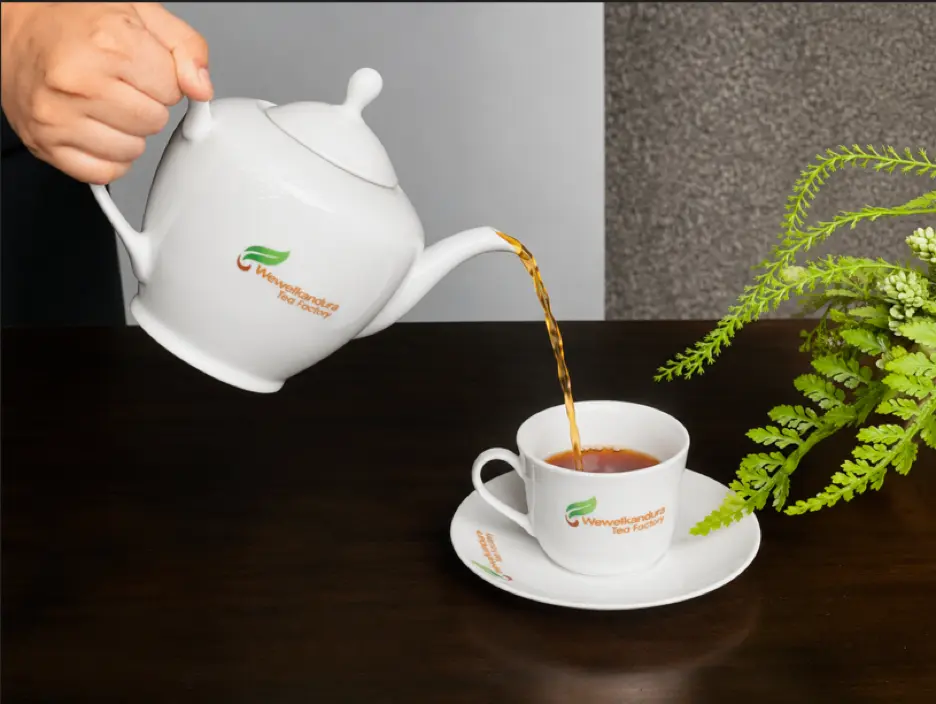
From Leaf to Cup: Our Processing Journey
The journey of Wewelkandura Tea from field to cup, guided by careful leaf handling, precise processing, and strict quality control.
The Journey of Wewelkandura Tea From Field to Cup
It Starts in the Field
Every exceptional cup of tea begins long before the leaves reach the factory. At Wewelkandura Tea Factory, quality starts in individual tea planters' gardens, where experienced farmers begin their work at first light. Farmers select only the finest shoot — two leaves and a bud — from tea bushes that have been carefully nurtured through years of expert cultivation, pruning, and fertilization.
By mid-morning, the freshly plucked leaves are digitally weighed, recorded, and transported to the factory under breathable covers to protect them from direct sunlight and premature oxidation.
Speed is critical. A bruised or wilted leaf can never recover its original quality. That is why every batch reaches Wewelkandura Tea Factory within two to three hours of plucking, preserving the freshness that defines premium Ceylon Tea.
Our commitment to excellence begins in the field and continues throughout every stage of production under internationally recognised food safety and quality management systems, including ISO 22000, HACCP, GMP, and Sri Lanka Tea Board quality standards.
Leaf Inspection
Every delivery of fresh green leaf is carefully inspected before entering the manufacturing process. Our quality team assesses leaf freshness, plucking standard, and the ratio of fine leaves to ensure only the highest-quality leaf is accepted.
Withering
Within hours of plucking, fresh leaf arrives at the factory for withering. Spread on large hessian trays — known in Sri Lanka as "withering troughs" — the leaves lose around 30% of their moisture over 12–18 hours. This softens the cell walls and primes the enzymes that will drive oxidation.
Fans push warm, controlled air up through the trough, evenly drawing moisture from the leaves. Our team monitors temperature, humidity, and airflow hour by hour. Under-withered leaf produces a grassy, raw cup; over-withered leaf loses its brightness. The goal is a supple, pliable leaf that can be rolled without breaking apart — the tea-makers test it simply by crushing a handful and feeling how the leaf yields.
Rolling
We produce orthodox rolled tea on selected batches. Orthodox rolling uses slower, gentler pressure to twist the leaf while keeping it largely intact — producing the wiry, long-leaf grades prized by loose-leaf connoisseurs. The choice of rolling method is made batch by batch, based on leaf quality, season, and the intended market.
Oxidation (Fermentation)
The rolled leaf is spread in a cool, humid room where oxidation transforms the green chlorophyll into the characteristic copper tones of black tea. Our experienced team monitors temperature and humidity closely; the window for perfect oxidation is often just 30–45 minutes.
During oxidation, the polyphenols in the leaf react with oxygen to form theaflavins and thearubigins — the compounds responsible for the amber colour, briskness, and depth of a good black tea. The room smells of apples, malt, and warm earth as the leaf transforms. A few minutes too long, and the tea turns muddy and flat; a few minutes too short, and it stays astringent and thin. Our head taster walks the oxidation room every fifteen minutes, judging the colour and aroma by eye and nose alone.
Drying
A hot-air dryer arrests oxidation and drops moisture to a safe 3%. The leaf emerges crisp, dark, and intensely aromatic — its complex flavours locked in.
Our dryer runs at a controlled 90–110 °C for around 20 minutes. Too hot, and delicate aromatics are destroyed; too cool, and residual moisture will lead to mould during storage. The leaf darkens and takes on the familiar metallic sheen of finished black tea. This is the point at which what was a living leaf becomes a shelf-stable ingredient, ready to travel across the world.
Grading and Sorting
Precision grading ensures consistency in every made tea batch. Using a series of vibrating sieves, the dried tea is separated into internationally recognised grades including BOP (Broken Orange Pekoe), FBOP, Pekoe, OP, Dust, and other market-specific classifications.
A sequence of sieves, each with progressively finer mesh, separates the dried tea into precise size grades. Following sieving, winnowing and magnetic separation remove fibre, stalks, and any trace of metal to ensure the highest standards of cleanliness and food safety.
To achieve even greater consistency, Wewelkandura Tea Factory employs the latest grading and sorting technology. Our factories are equipped with advanced five-stage and four-stage colour sorters, which use high-precision optical sensors to identify and remove discoloured particles, stems, foreign matter, and any defective tea. This state-of-the-art technology ensures exceptional uniformity, purity, and quality in every batch, enabling us to consistently meet the stringent requirements of international tea markets.
Quality Control
Every batch is cupped by our in-house tea taster before dispatch. We evaluate colour, clarity, aroma, and flavour against international SLTB standards. Only teas that meet the mark carry the Wewelkandura name.
In a traditional tea-tasting room, 2.8 grams of dry leaf is brewed for exactly six minutes in a standardised porcelain pot. The liquor is poured, the infused leaf examined, and three senses — sight, smell, and taste — come together to score the batch. Our head taster, with over 25 years of experience, can identify a problem batch before most would notice anything at all: a faintly stewed note, a hint of smokiness, a whisper of dullness in the cup.
Packing and Distribution
Once approved, the tea is moved to our bulk-packing floor. Multi-wall paper sacks lined with food-grade aluminium foil are filled, nitrogen-flushed, and heat-sealed to protect the tea from moisture and light during the long sea journey ahead. Each sack is labelled with the Wewelkandura and Kothmale mark. The traceability trail connects the cup in a customer's hand back to the specific day and row in which its leaves were plucked.